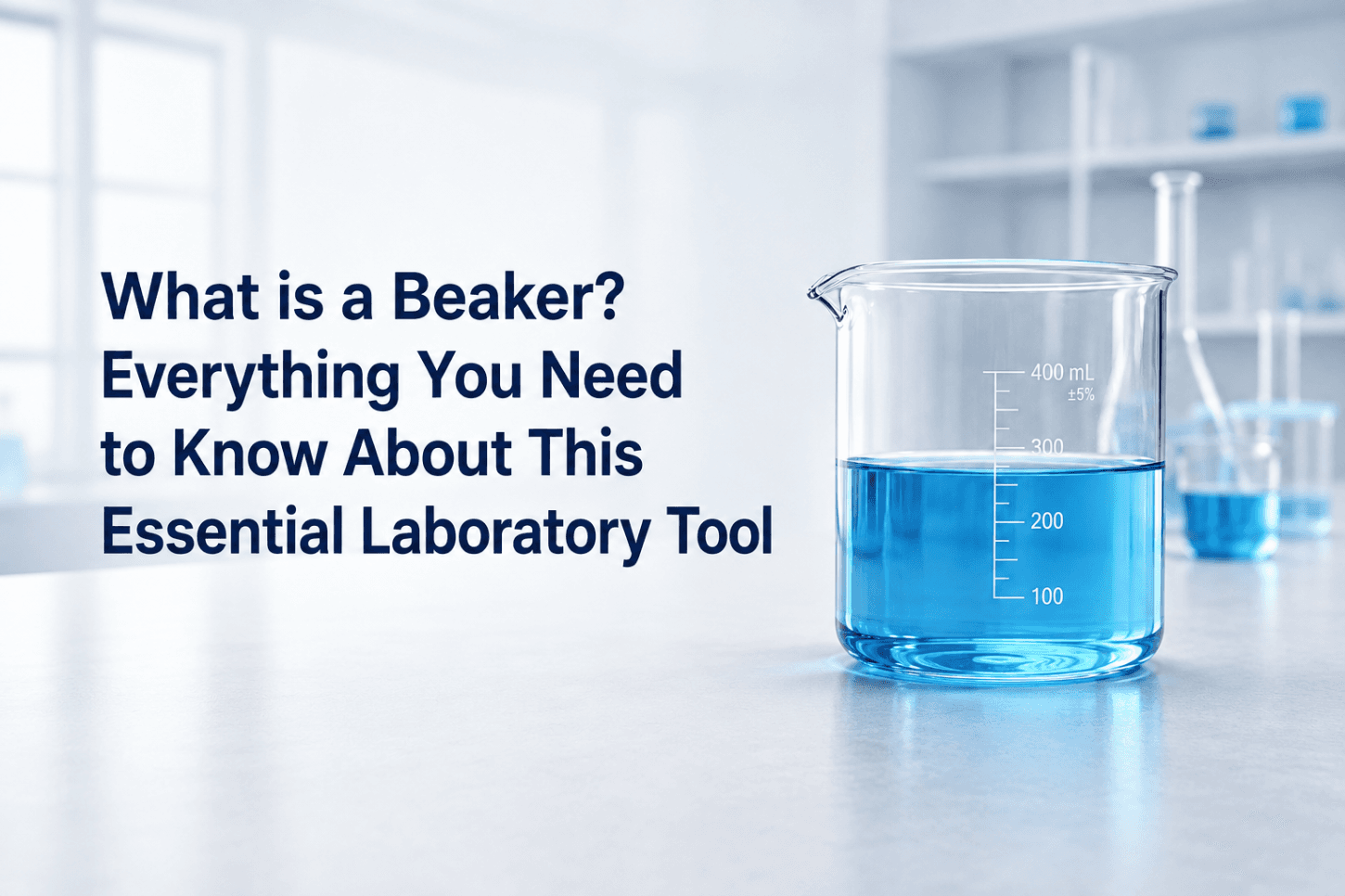
Short answer: Borosilicate glass is a silica-based glass containing boron oxide. Its low thermal expansion, strong resistance to thermal shock and broad chemical resistance make it a preferred material for laboratory beakers, flasks, bottles, measuring cylinders and reaction vessels. The most familiar laboratory grade is borosilicate glass 3.3, also called Boro 3.3, whose material properties are specified in ISO 3585.
Borosilicate glass is widely used across South African mining, minerals, water-quality, food, pharmaceutical, university and industrial laboratories. From digestion and solution preparation to reagent storage and routine teaching, it provides a practical combination of visibility, chemical durability and resistance to temperature change.
The material offers a valuable balance. It is transparent, reusable and can be manufactured into many laboratory shapes, yet it withstands temperature changes and chemical exposure better than ordinary soda-lime glass. However, the word borosilicate does not make every product suitable for every chemical, temperature, vacuum or pressure condition. Understanding the material and the complete product specification helps laboratories select safer, longer-lasting laboratory glassware.
1What is borosilicate glass made from?
Borosilicate glass is an inorganic glass made primarily from silica, with boron oxide added as a major glass-forming component. Smaller quantities of alkali oxides and aluminium oxide are commonly included to control melting, durability and manufacturing performance. Exact formulations vary between manufacturers and glass families.
Boron is the key difference. Ordinary soda-lime glass expands and contracts more as its temperature changes. The boron-containing structure of borosilicate glass reduces this movement, so less internal stress develops during heating and cooling. Properly manufactured borosilicate labware is therefore less likely to crack from thermal shock than comparable soda-lime glassware.
What is Boro 3.3? Borosilicate glass 3.3 is a standard low-expansion material used widely for laboratory apparatus. The number 3.3 refers to its linear coefficient of thermal expansion, approximately 3.3 × 10⁻⁶ K−1. ISO 3585 specifies the characteristics of this glass type. Trade names may differ, so buyers should check the stated glass composition and product standard instead of relying on appearance alone.
2Why do laboratories use borosilicate glass?
Borosilicate glass supports heating, cooling, observation, storage and cleaning across many laboratory applications. Its most valuable properties include:
- Low thermal expansion: the glass changes dimensions very little as its temperature changes, reducing thermally induced stress.
- Thermal shock resistance: it tolerates faster and larger temperature changes than common soda-lime glass when the item is sound and used within its limits.
- Broad chemical resistance: it performs well with water, many acids, neutral and acidic salt solutions and numerous organic substances.
- Optical clarity: clear walls allow users to observe colour, phase separation, boiling, precipitation and liquid level.
- Smooth, non-porous surface: the surface is easy to clean and is less likely to retain sample material than porous surfaces.
- Dimensional stability: low expansion helps calibrated and jointed glassware maintain consistent dimensions during routine temperature changes.
- Reusability: suitable items withstand repeated cleaning and sterilisation cycles, reducing reliance on disposable vessels.
These properties are especially valuable in South African laboratories working with mineral samples, water and wastewater, agricultural products, food, pharmaceuticals and industrial materials. One well-selected glass type can support preparation, heating, observation and cleaning while helping laboratories standardise repeat procedures.
These properties make borosilicate glass useful for laboratory beakers, flasks, reagent bottles, condensers, burettes, pipettes and glass measuring cylinders. Specialist glassware also includes columns, manifolds, adapters and custom reaction apparatus.
3Borosilicate glass vs soda-lime glass
The clearest difference between borosilicate and soda-lime glass is their response to heat. Soda-lime glass is economical and works well for many room-temperature containers, disposable items and general packaging applications. Borosilicate glass expands much less when heated, making it the stronger choice for laboratory work involving thermal cycling or direct observation of heated samples.
- For heating and cooling: borosilicate glass is generally preferred because its lower expansion reduces thermal stress.
- For chemical work: borosilicate usually provides better hydrolytic and acid resistance, supporting cleaner storage and processing of many reagents.
- For routine room-temperature storage: either material may be suitable when its chemical compatibility and container specification match the application.
- For cost-sensitive, single-use applications: soda-lime glass can be practical when high thermal resistance is unnecessary.
- For precision laboratory apparatus: Boro 3.3 is commonly selected for its stability, durability and compatibility with standard laboratory designs.
Not all clear laboratory glass is borosilicate, and colour is not a reliable identifier. Read the product description, markings and technical documentation. If the application involves heat, vacuum, pressure, hazardous chemicals or critical analytical work, confirm both the material and the intended use of the complete product.
Common uses of borosilicate glass in South Africa
Borosilicate glass is found wherever users need visibility together with heat and chemical resistance. Typical South Africa applications include:
- preparing and heating samples in mining and minerals laboratories
- supporting water, wastewater and environmental analysis
- mixing and storing reagents used in food and agricultural testing
- handling compatible solutions in pharmaceutical quality control
- teaching practical chemistry in schools, colleges and universities
- building reflux, distillation, filtration and gas-washing assemblies
For light-sensitive materials, amber borosilicate bottles can reduce the transmission of selected ultraviolet and visible wavelengths. The protection level depends on the product specification, so amber colour alone should not be treated as proof that a bottle protects a particular substance.
What can damage borosilicate glass?
Borosilicate glass has broad chemical resistance, but it is not universally inert. Hydrofluoric acid attacks silicate glass and must not be stored or processed in standard borosilicate vessels. Strong alkaline solutions, particularly when hot or concentrated, can erode the surface. Hot concentrated phosphoric acid can also attack glass. Always assess the chemical, concentration, temperature and contact time together.
Mechanical damage is equally important. Scratches, chips and star cracks concentrate stress and can cause a vessel to fail during heating, cooling, evacuation or handling. Abrasive cleaners, glass-to-glass contact and overtightened clamps can shorten service life. Inspect glassware before every critical procedure and remove damaged items from service.
How to choose borosilicate laboratory glassware
Start with the application rather than the vessel name. A suitable product should match the required volume, accuracy, temperature, chemical exposure, pressure conditions and handling method.
- Confirm the glass grade: look for borosilicate 3.3 or another clearly identified composition appropriate for the method.
- Check the relevant standard: ISO 3585 covers material properties, while individual products may conform to separate standards for beakers, bottles, flasks or volumetric ware.
- Match form to function: choose a beaker for general mixing, a conical flask for swirling, calibrated volumetric ware for quantitative preparation and a purpose-designed bottle for storage.
- Review accuracy: graduations on general-purpose beakers and bottles are usually approximate. Use Class A or Class B volumetric glassware when a defined tolerance is required.
- Check temperature limits: use the manufacturer's rating for the exact item, including any cap, seal, coating, joint or printed scale.
- Assess pressure and vacuum: never assume a standard bottle or flask is pressure-rated. Use vessels specifically designed and documented for vacuum or pressure service.
- Consider traceability: certificates, serialisation or retrace codes may be useful in regulated, quality-controlled or audited laboratories.
South African laboratories should match glassware to the method, reagent concentration, operating temperature and required documentation. Mining, environmental and regulated quality-control facilities may also need batch certificates, calibration information or traceability features that support their internal quality systems.
When sourcing glassware for a South African laboratory, assess the complete application instead of selecting by capacity alone. Confirm the glass grade, relevant standard, accuracy class, connection or closure, cleaning method and any pressure or vacuum requirement before ordering.
How should borosilicate glassware be cleaned and handled?
Allow hot glassware to cool in a controlled manner before washing. Use a compatible laboratory detergent and non-abrasive brush, then rinse as required by the analytical method. Avoid steel wool, damaged brushes and cleaning tools that can scratch the surface. Inspect rims, bases, sidewalls, joints and graduation areas under good lighting before reuse.
Many borosilicate laboratory products can be autoclaved, but check every component first. Caps may need to be loosened or vented to prevent pressure build-up, and seals or coatings may have lower temperature limits than the glass. Follow the manufacturer's instructions for loading, cycle conditions, cooling and handling.
Frequently asked questions
What is borosilicate glass made from?
Borosilicate glass is made mainly from silica and boron oxide, with smaller amounts of alkali oxides and aluminium oxide. Adding boron changes the glass network and gives it a much lower rate of thermal expansion than ordinary soda-lime glass.
What does borosilicate glass 3.3 mean?
The 3.3 refers to the material's linear coefficient of thermal expansion, approximately 3.3 × 10⁻⁶ K⁻¹. This low expansion helps Boro 3.3 tolerate temperature changes better than common soda-lime glass. Its material properties are specified in ISO 3585.
Why is borosilicate glass used in South Africa laboratories?
South African laboratories use borosilicate glass for its thermal stability, chemical resistance, clarity and reusable surface. It is well suited to mining, water, food, pharmaceutical, education and industrial applications when the individual product matches the method and operating conditions.
Is borosilicate glass heat resistant?
Yes. Borosilicate glass is highly heat resistant and expands very little as its temperature changes. It can still fail if it is scratched, chipped, heated unevenly or exposed to excessive thermal shock, so the manufacturer's limits and safe heating instructions must be followed.
Is borosilicate glass resistant to every chemical?
No. Borosilicate glass resists water, many acids, salt solutions and organic substances, but hydrofluoric acid attacks glass. Hot concentrated phosphoric acid and strong alkaline solutions can also damage it. Check the exact reagent, concentration, temperature and exposure time.
Can borosilicate glass go in an autoclave?
Many laboratory products made from borosilicate glass are autoclavable, but the complete item must be checked first. Caps, seals, coatings, graduations and attachments may have different limits. Bottles should normally be vented or have their caps loosened according to the manufacturer's instructions.
Need borosilicate laboratory glassware in South Africa? Compare beakers, bottles, measuring cylinders and related glassware for mining, water, food, pharmaceutical, education and industrial laboratories.
Shop Laboratory Glassware South Africa